 Chroma
Launch app →Lending against tokenized equities
Borrow against your shares.
Without selling them.
Post a stock token as collateral and draw stablecoins against it, without giving up whatever it does next. Every market here carries the one figure that decides whether a position is actually safe: how long ago the price behind it last moved. During a session that reads in minutes. Across a weekend, in days.
How it works
Four steps, and one number that decides whether the third of them was a good idea.
- 01
Pick an isolated market
A market is one pairing: a stock token, a stablecoin, the oracle that prices them and the limit at which the loan is called. Nothing is pooled across markets, so a failure in one cannot reach into another — and it also means you are choosing which oracle you trust, not inheriting an average of all of them.
- 02
Post collateral
Your stock tokens move into the market contract and sit there. They are not lent to anyone, not rehypothecated, and they keep whatever the underlying share does next. The limit written into the market decides how much of their value you may draw against.
- 03
Draw stablecoins
Borrow up to the limit and the stablecoins land in your wallet. There is no term and no schedule: interest accrues every second against the pool, you repay whenever you like, and the rate moves with how much of the pool is lent out.
- 04
Watch the price age
Your safety margin is a claim about a price. A tokenized share trades all week, but the feed behind it only publishes when the underlying market is open — so from Friday's close the number your position is judged against simply stops. That gap is on every market here, in hours.
Try it against a real limit
A $1,000 position in an equity market, against that market's own liquidation limit of 62.5%. Move the amount you borrow.
A 36% cushion is only worth what the price behind it is worth. If that price last moved on Friday afternoon, the cushion is measured against a number nobody has checked since — which is the number this site puts on every market.
The price does not go stale slowly. It stops.
The feed publishes on a half-percent move, or once a day if nothing moves. Neither can happen while the exchange behind it is shut. Friday's close is Saturday's price, Sunday's price, and most of Monday morning's. Then it catches up in one step.
- Price held
- 65 h
- Interest paused
- 0 h
- Catch-up
- 1 step
Your loan accrues through every one of those hours. Nothing on screen moves, and then on Monday everything does at once. Chroma cannot make an old price current. It can tell you, on every market and before you sign, exactly how old the one you are relying on is.
Everything in one view
Three things this interface does that a price alone cannot tell you.
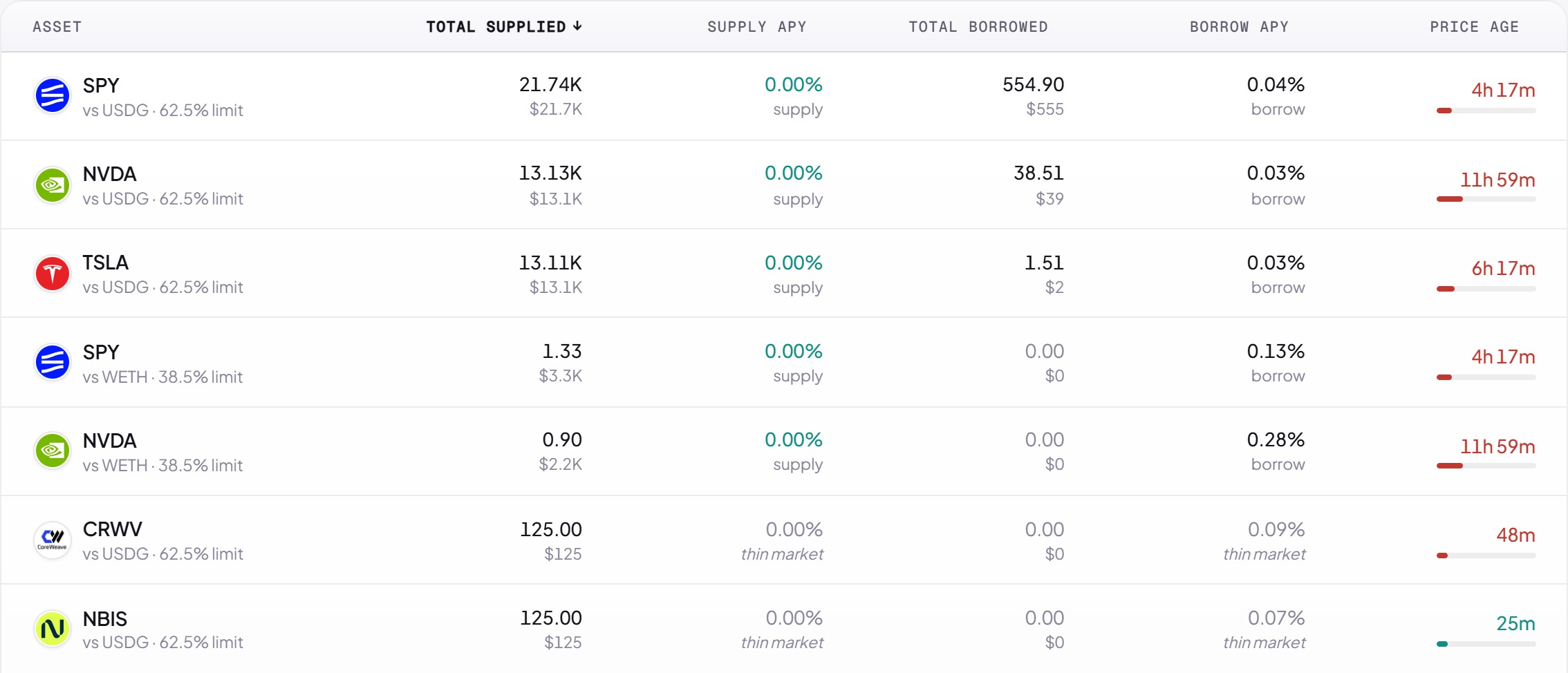
Every market, with its price age
All fifty-four equity markets on the chain in one table, each carrying the number nobody else prints: how long since the price behind it last moved. In a session it reads in minutes. Across a weekend, in days.
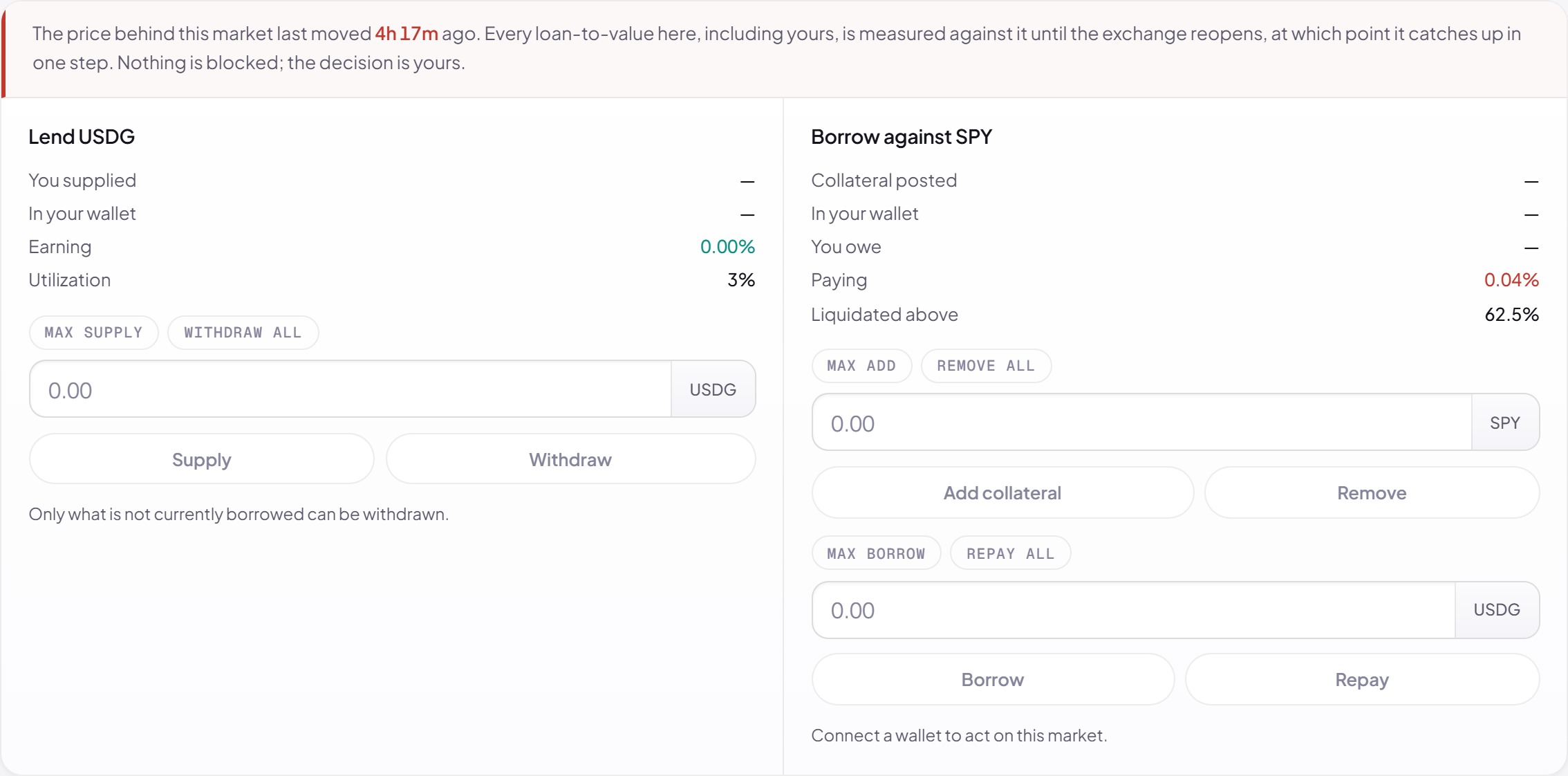
Lend and borrow side by side
Supply to earn what borrowers pay, or post collateral and draw against it — both on one screen, with the liquidation limit and what you currently owe in front of you before you sign anything.

Told plainly when a price is old
A stale price is flagged, never blocked. Refusing to price an asset would freeze liquidations too, and that leaves lenders worse off than a warning does. You are shown the age and the decision stays yours.